German businesses face some of the strictest privacy rules in the world. These are the technical details we get right on every website we build.
If you run a website in Germany, privacy isn't optional. The GDPR (DSGVO), the German TDDDG and court decisions set clear rules — and warning letters (Abmahnungen) for simple mistakes are unfortunately common. The good news: most issues are technical and can be solved once, properly. This article is general information, not legal advice.
1. Only track after consent
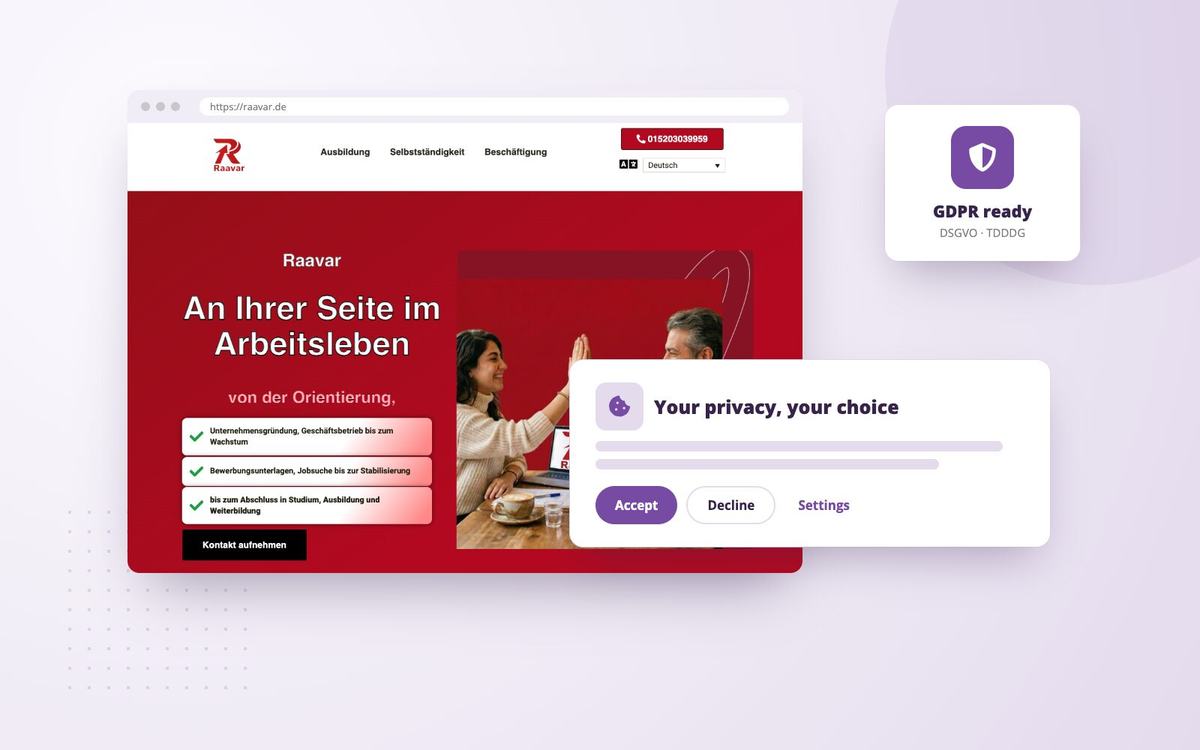
Analytics and advertising tools such as Google Analytics or the Meta Pixel may only be loaded after a visitor actively agrees. That means the scripts must not run on page load “just in case”. A proper consent banner offers Accept and Decline with equal prominence, and visitors must be able to change their choice later.
2. Host your fonts yourself
Loading Google Fonts directly from Google's servers sends each visitor's IP address to Google. In 2022, a Munich court ruled that doing this without consent violates the GDPR. The fix is simple: download the font files and serve them from your own server. We do this on every site by default.
3. Watch your third-party scripts
The same logic applies to embedded maps, YouTube videos, chat widgets and scripts loaded from public CDNs. Self-host what you can, and load the rest only after consent — for example with a “click to load the map” placeholder.
4. Forms: collect only what you need
- Ask only for data you actually need to answer the request.
- Mark optional fields clearly.
- Link to your privacy policy right next to the submit button.
- Transmit everything over HTTPS and delete old enquiries regularly.
5. Choose hosting in the EU
Hosting your website and your form data on servers in Germany or the EU — with a data processing agreement (AVV) with your provider — removes a whole category of questions about international data transfers.
6. Keep your legal pages up to date
Every business website in Germany needs an Impressum and a privacy policy that matches what the site actually does. Whenever you add a new tool — a newsletter, a booking system, an ad pixel — update the privacy policy too.
Privacy-friendly websites are usually faster and more trustworthy as well. If you're not sure where your site stands, we're happy to take a look.